In the global coffee supply chain, filter paper is often treated as a “supporting actor.” However, when it comes to international logistics, it is one of the most challenging commodities to manage. Because coffee filters are high-volume, low-value, and moisture-sensitive, shipping costs can easily account for 20% to 40% of your Landed Cost (CIF).
To truly move the needle on your margins, you need a strategy that goes beyond simple rate negotiation. It requires a holistic approach—from optimizing packaging density to sophisticated tax and inventory modeling.

1. Density Management: Beating the “Volumetric” Trap
The biggest hurdle in coffee filter logistics is that carriers typically charge based on the space a box occupies rather than its actual weight. In the industry, this is known as the “light and bulky” penalty.
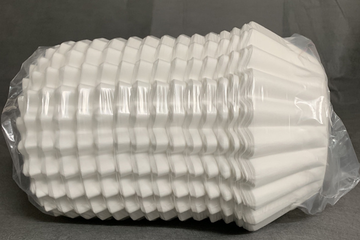
- Compression Packaging: Premium suppliers utilize industrial-grade compression to eliminate trapped air between filters. If you can reduce carton height by just 15%, you are effectively reducing your sea freight bill by 15%.
- The Volumetric Weight Logic:Calculation: Volumetric Weight = (Length x Width x Height) / 6000 Note: Using centimeters (cm). If this result is higher than the actual weight, you are charged for the volume. Optimizing packaging is your first line of defense.
2. Strategic Tax Planning: Leveraging HS Codes and Trade Agreements
Total Cost of Ownership (TCO) isn’t just about the freight bill; it’s about what happens at the customs terminal.
- Precision Classification: The standard HS code for coffee filters is 4823.20.00. Ensuring your paperwork is exact prevents overpayment of duties or costly customs delays.
- The Duty Calculation Logic:Total Duty = CIF Value (Cost + Insurance + Freight) x Duty Rate VAT/GST = (CIF Value + Total Duty) x Tax Rate
- Optimization Tip: Leverage regional trade agreements (such as RCEP). Obtaining a Certificate of Origin can often drop your duty rate to 0%, providing an immediate boost to your bottom line.
3. Container Strategy: Finding the FCL vs. LCL Breakeven Point
When ordering in bulk, choosing between Less-than-Container Load (LCL) and Full Container Load (FCL) should be a data-driven decision, not a guess.
- The Breakeven Calculation:Breakeven Volume (CBM) = Total FCL Fixed Costs / LCL Rate per Cubic Meter
- Expert Insight: Because coffee filters are prone to crushing and humidity, FCL is almost always the superior choice. Even if your order only fills 70% of a 20ft container, opting for Full Container Load (FCL) often results in a lower per-unit cost and significantly less damage from handling compared to “consolidated” shipping.
4. Inventory Synergy: Balancing Freight Discounts with Holding Costs
While bulk purchasing earns you deeper freight discounts, it also ties up capital and increases storage fees.
- The Economic Order Quantity (EOQ) Model:Optimal Order Size = Square Root of [ (2 x Annual Demand x Cost per Order) / Annual Holding Cost per Unit ]
- The Takeaway: Since coffee filters are shelf-stable and have low individual unit value, their holding cost is relatively low. This mathematically supports a “Low-Frequency, High-Volume, FCL” shipping strategy. Transitioning from monthly small shipments to 2–3 massive container loads per year can slash overall logistics costs by over 25%.
5. Time is Money: Accounting for Capital Interest
Logistics costs are also hidden in the calendar—especially for large-scale wholesale orders.
- The Cost of Transit Logic:Transit Cost = Total Cargo Value x Annual Interest Rate x (Days in Transit / 365)
- Route Selection: While rail freight might carry a higher sticker price than sea freight, if it cuts 20 days off your transit time, the interest saved on your tied-up capital may actually make it the cheaper option in a “total cost” analysis.

0 Comments