What is a #4 coffee filter?
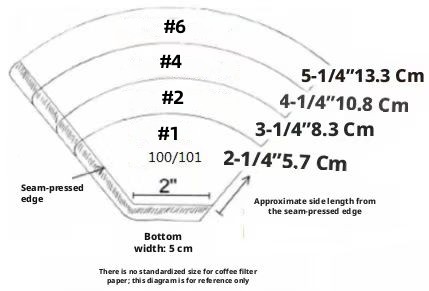
A #4 coffee filter is a common size of coffee filter, with the following main characteristics: Size and Shape: Typically fan-shaped or cone-shaped, the specific shape depends on the type of dripper used. For example, a common fan-shaped #4 filter has an unfolded diameter of approximately 12 cm, compatible with most American drip coffee makers (such as BUNN and Philips) and some pour-over drippers, suitable for making coffee for 3-4 people.
Material and Characteristics: Mostly made of wood pulp or bamboo pulp, some are bleached, and some retain their natural wood color.
Compared to #1 and #2 filters, #4 filters are usually thicker with relatively smaller pores, allowing for more thorough interception of coffee grounds and some oils, resulting in a richer, clearer coffee flavor with less impurity.
Suitable Scenarios: Suitable for medium-dark roast beans, highlighting the caramel flavor and body of the coffee.
Used in automatic drip coffee makers or pour-over drippers, it ensures even water flow through the coffee grounds, avoiding channeling effects and improving extraction uniformity.
Note that the specific size and specifications of “#4 filter paper” may vary slightly between different brands. It is recommended to confirm compatibility with your filter cup before use.
What coffee makers use #4 filters?
Coffee makers that typically use #4 filters are mainly American drip coffee makers, but the specific type depends on the filter basket design. #4 filters are large, tapered (V-shaped) or round-bottomed filters, larger than the more common #2 and #1 filters, suitable for making multiple servings (4 cups or more) of coffee at once.
The following coffee makers typically use #4 filters: Full-size American drip coffee makers (10-12 cup capacity) Most common 10-cup or 12-cup American drip coffee makers in households have larger filter baskets, which perfectly match the #4 tapered filter paper. Examples include: standard models from brands such as Bosch, Philips, De’Longhi, and Melitta (the brand that defined the #4 filter paper specification).
Classic models like the Melitta Look and Technivorm Moccamaster (some larger models) also use size 4 filter paper.
Some commercial or high-capacity drip coffee makers
For example, flat-bottomed or conical basket models used in hotels and restaurants (such as some models from Bunn and Fetco).
Note: Flat-bottomed baskets are not suitable.
If your coffee machine’s basket is a flat, fan-shaped design (like many Panasonic and Siemens entry-level models), it typically uses size 4 flat-bottomed filter paper (i.e., “basket-shaped filter paper”), not conical size 4. Flat-bottomed size 4 is wider and shallower than conical size 4, and the two are not interchangeable.
How to confirm if your coffee machine uses size 4 conical filter paper?
Check the instruction manual or the label on the basket (some may say “Size 4”).
Test: Place a size 4 conical filter paper in the basket. If the edge fits snugly against the inner wall of the basket, and the tip of the filter paper just touches the center hole at the bottom of the basket, it’s correct. Common Alternatives: If the instruction manual specifies “large conical filter paper,” 8-12 cup models usually use size 4; sizes 2 are commonly used for 6 cups or less.
Are size 2 or 4 coffee filters bigger?
Size 4 coffee filters are larger than size 2.
Specific size differences are as follows:
Size 4: Suitable for 10-12 cup American drip coffee makers, typically with a wider top opening and a deeper cone.
Size 2: Suitable for 2-6 cup small American drip coffee makers or some pour-over filter cups (such as the Hario V60), significantly smaller than size 4.
Buying Tip: If your coffee machine’s filter basket is large, size 2 filter paper is easily collapsed, torn, or fails to filter properly due to its shallowness; while size 4 can usually be used with a slightly larger filter basket by manually folding the edges, but this is not recommended for long-term use.
How to use a number 4 coffee filter?
A #4 coffee filter usually refers to a specific size or model of filter paper, commonly found in fan-shaped or cake-shaped types. Here are the general usage steps:
Confirm Compatibility: Check if the filter paper shape matches the filter cup. For fan-shaped filters, use Kalita, Melitta, etc.; for cake-shaped filters, use flat-bottomed filters. Ensure the filter paper size matches the filter cup size to avoid leakage or difficulty in pouring water due to being too large or too small.
Fold the Filter Paper (if necessary): If the filter paper has creases or needs folding, first fold up the side along the crease and flatten it, then fold up the bottom from the back and flatten it. Ensure the fold is neat and the filter paper fits the shape of the filter cup.
After folding, unfold it and check for flatness, wrinkles, or twists.
Pre-rinse the Filter Paper: Place the filter paper in the filter cup and pour hot water (approximately 85-93℃) from the center to completely saturate the filter paper, rinsing away any residual pulp taste or impurities. If using natural wood-colored filter paper, rinse 2-3 times until the paper smell is gone; bleached filter paper usually only needs one rinse.
Add Coffee Grounds
Pour the ground coffee evenly into the filter paper. The amount of coffee grounds depends on the size of the filter cup and your brewing needs (generally 15-20 grams of coffee grounds for 1-2 servings).
Gently tap the side of the filter cup to even out the coffee grounds, avoiding any buildup or gaps.
Pour Water
Start pouring water from the center with a steady stream, gradually moving outwards in a circular motion to ensure the water evenly passes through the coffee grounds and extracts the coffee.
During the pouring process, observe whether the filter paper adheres tightly to the filter cup to prevent water from overflowing from the edges.
Brewing Completed
Once all the coffee has flowed into the lower pot or receiving container, turn off the water flow, remove the filter paper, and enjoy your coffee.
Note: If the filter paper leaks or spills during brewing, it may be due to a loose fit between the filter paper and the filter cup. Try folding or adjusting the position of the filter paper.
Different brands and models of No. 4 filter paper may vary slightly in thickness and flow rate. You can adjust the water injection speed and powder amount according to the actual brewing effect.
0 Comments