In specialty coffee brewing, many baristas often wonder: why, with the same grind size, water temperature, and technique, does changing the filter paper drastically alter the coffee’s acidity, body, and cleanliness? The core secret lies in the paper’s fiber material, weave density, and adsorption properties.
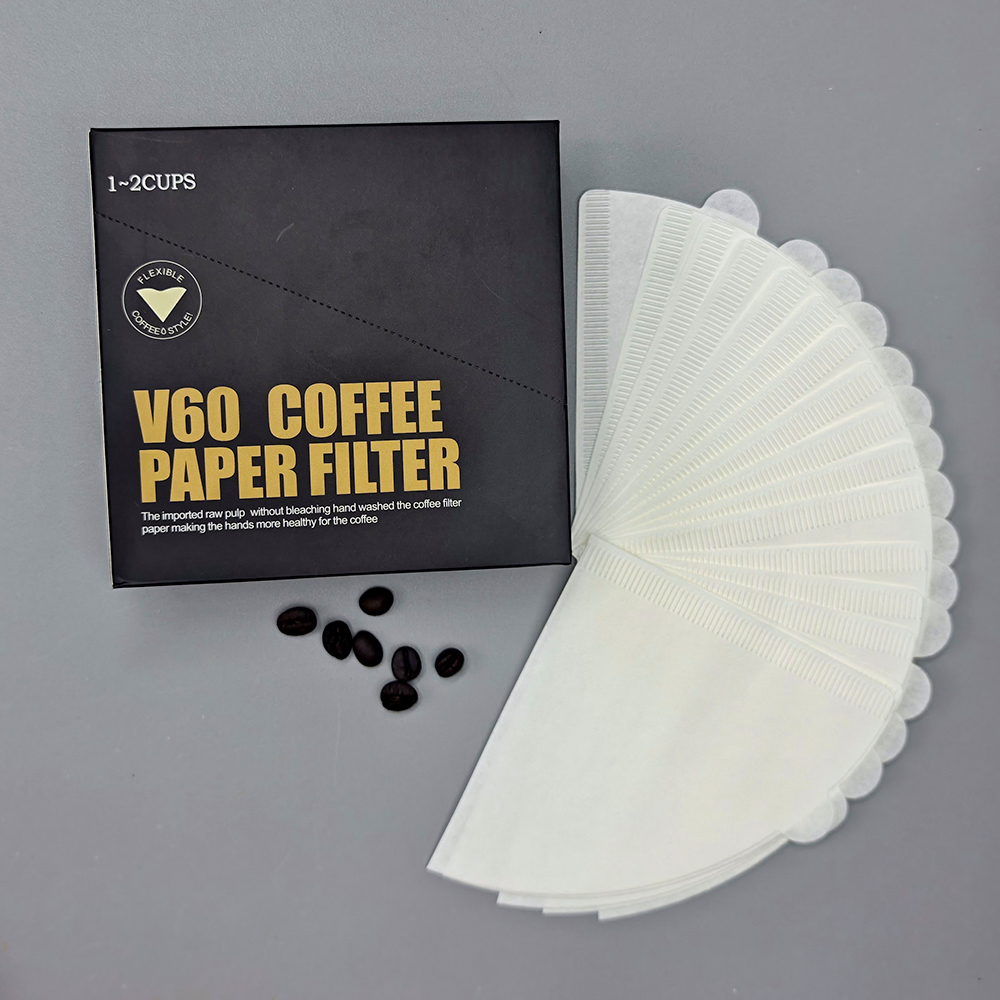
Today, we’ll delve into the fundamental differences in brewing performance between traditional 100% pure wood pulp filter paper, bamboo fiber composite filter paper, and Abaca fiber composite filter paper from the perspective of plant fiber fluid dynamics.
1. Traditional 100% Pure Wood Pulp Filter Paper
— The Cornerstone of Classic Balance and High Cleanliness
Traditional specialty coffee filters (such as Hario V60 and Chemex) are mostly made from 100% softwood pulp. Softwood pulp fibers are characterized by moderate length (typically around 2–4 mm) and uniform thickness.
- Physical Fluid Dynamics: During the papermaking process, pure wood pulp fibers form a very homogeneous and tightly interwoven network. Its pore distribution is extremely regular, resulting in a very high capture rate of coffee fines.
- Flow Rate: Medium to slow. As brewing progresses, the water flow through the homogeneous wood pulp fibers experiences stable resistance, and then exhibits a linear decrease in speed in the later stages due to the embedding of fines.
- Impact on Flavor (Extraction Characteristics): * Extremely High Clarity: Wood pulp has the strongest adsorption capacity for coffee oils (such as cafestol) and tiny suspended particles, thoroughly filtering out any grainy texture.
- Flavor Profile: Distinct layers, with a very linear transition between acidity and sweetness. However, if brewing techniques are improper (such as excessive water cut-off), the later stages can easily lead to the extraction of unwanted woody bitterness due to slight water blockage. Additionally, wood pulp filter paper that is not thoroughly wetted can easily have a noticeable “paper flavor.”
2. Bamboo Fiber Composite Filter Paper (10% – 20% Bamboo Fiber)
— A Catalyst for Improved Water Flow and Brighter Acidity
Bamboo, a herbaceous plant, has fibers that are harder, more rigid, and have a smoother surface compared to wood pulp fibers. When 10%–20% bamboo fiber is incorporated into filter paper, the paper’s microscopic physical structure undergoes a qualitative change.
- Physical Fluid Dynamics: Due to the high rigidity and resistance to bending of bamboo fibers, when mixed and interwoven with wood pulp, they act like micro-scaffolds, opening up the tight gaps between the wood pulp fibers. This results in larger capillary pores within the filter paper, creating a more three-dimensional space.
- Flow Rate Performance: Relatively fast and stable. The large pore size and smooth bamboo fiber surface allow hot water to penetrate the paper wall more unimpeded, reducing the likelihood of severe water blockage, even with lightly roasted beans that are prone to fine powder formation.
- Impact on Flavor (Extraction Characteristics):
- Amplified Bright Acidity: High flow rate shortens the residence time of short-chain acids (such as malic acid and citric acid) in the filter cup, avoiding the suppression of acids by high water temperature, making the initial floral and fruity aromas more vibrant and lively.
- Nearly Zero Paper Taste: Bamboo fiber is naturally hydrophilic and free of lignin impurities, eliminating the need for extensive hot water “washing” before brewing.
- Flavor Profile: Extremely suitable for light and very light roasts of premium beans (such as Ethiopian and Geisha), emphasizing ultimate freshness and fruity notes.
3. Abaca Fiber Composite Filter Paper (10% – 15% Abaca Fiber)
— A Master of Balancing High Flow Rate and Rich Body
Abaca (Manila hemp) is a recognized representative of ultra-long fibers in the plant kingdom. It is not a true hemp but a relative of the banana plant family. Its fibers are not only extremely tough with high tensile strength, but their surfaces also possess a unique microporous and multi-layered structure.
- Physical Fluid Dynamics: The 10%–15% Abaca fibers, woven like a very strong but large-mesh “fishing net,” crisscross between the wood pulp. This “long-short combination” mesh structure ensures excellent stability of the filter paper when wet (it resists collapsing or sagging under the weight of water) and forms a unique physical matrix that is high-density yet highly porous.
- Flow Rate Performance: Fast at the beginning and slow at the end (intelligent speed control). In the initial brewing stage, the large Abaca mesh allows water to flow quickly, bringing out excellent, delicate flavor notes. In the middle and later stages, the long fiber mesh acts like a physical magnet, evenly catching and holding the coffee grounds on the mesh surface rather than letting them pile up at the very bottom of the filter cone. This achieves a smooth flow rate braking in the middle and later stages.
- Impact on Flavor (Extraction Characteristics):
- Body & Sweetness: Abaca fibers allow a controlled amount of aromatic oils and soluble solids in the coffee to pass through, while the slower extraction speed at the end of the pour prolongs the contact time for heavier, caramelized substances.
- Flavor Indicators: While maintaining excellent cleanliness, it significantly enhances the viscosity, sweetness, and aftertaste of the coffee. It’s a versatile filter paper, allowing light and medium roasts to achieve a more rounded, juicy, and full-bodied flavor, while perfectly bringing out the chocolate and nutty notes of medium and dark roasts (such as Mandheling and Brazilian coffee).
Summary: The Barista’s Selection Strategy
Understanding the underlying fluid dynamics of these three materials allows us to precisely select the filter paper for different coffee beans, much like blending a recipe:
| Filter Material | Microscopic Structure | Flow Rate Tendency | Best Suited For / Flavor Goal |
| 100% Pure Wood Pulp | Homogeneous layering, uniform and regular pores. | Medium to Slow | Standard brewing, looking for classic balance, clean layers, and high clarity. |
| 10% – 20% Bamboo Fiber | Rigid scaffolds, larger capillary pores. | Consistently Fast | Light / ultra-light roasts. Accentuates vibrant acidity and florals while bypassing late-stage bitterness. |
| 10% – 15% Abaca Fiber | Long-fiber mesh network, highly porous matrix. | Fast Early, Slow Late | Medium-to-dark roasts, or thin light roasts where you want to boost sweetness, syrupy body, and a long aftertaste. |
0 Comments