Selecting commercial coffee filter paper is far more than a simple decision regarding consumable expenses. In the commercial coffee brewing process, the filter paper acts as the “final guardian” of extraction quality. In an era where competition in commercial coffee has shifted to the nuances of flavor profiles, filter paper is no longer merely an absorbent sheet; it is a crucial factor ensuring extraction uniformity and flavor clarity.
This article examines the selection of high-capacity filter paper from a practical operational perspective, focusing on three critical dimensions: extraction stability, material safety, and comprehensive cost control.
There is a vast performance gap between home-use and commercial-grade filter papers. The requirements for commercial environments go well beyond simply being “larger.”
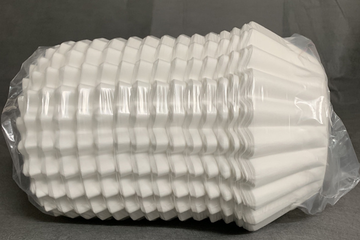
Commercial coffee machines—such as the high-volume batch brewers from brands like BUNN and FETCO—often need to brew several liters of coffee at once during peak hours. This demands that the filter paper possess sufficient structural rigidity and volume to support hundreds of grams of wet coffee grounds. Standard filter papers tend to collapse or cling to the inner walls when wet, impeding airflow and restricting the space available for extraction. In contrast, professional-grade commercial filters undergo specialized embossing or crimping processes, allowing them to hold their shape and fit the brew basket properly, thereby ensuring ample room for the hot water and coffee grounds to extract effectively. For operators managing high-volume setups, you can explore our specialized large coffee filters commercial collection designed precisely for heavy-duty brewers.
Flow rate is a silent driver of a coffee’s flavor profile. If the flow is too fast, extraction is insufficient, resulting in a weak, acidic brew; if it is too slow, over-extraction occurs, amplifying bitterness. The fiber density of commercial filter paper is precision-engineered to maintain a consistent flow rate even when large volumes of water are poured. This stability prevents sudden flow fluctuations caused by clogging or tearing, ensuring that every batch meets the intended flavor profile. For commercial operators striving for consistency, this is a fundamental guarantee of quality.
For a business serving hundreds of cups of coffee daily, the questions that truly matter are straightforward: Will the paper impart unwanted flavors? Can it withstand the demands of peak hours? Is it cost-effective in the long run?
1. First, consider whether the filter paper itself might compromise the flavor. Some inexpensive filters use chlorine-based bleaching agents to achieve whiteness; when hot water hits them, an unpleasant odor leaches into the coffee. The delicate floral and fruity notes of the premium beans you paid a high price for could easily be ruined by a single sheet of paper. Therefore, when purchasing, prioritize products labeled as chlorine-free; this ensures the paper won’t introduce off-flavors or overpower the coffee’s profile. While eco-friendly materials are certainly worth advocating for, in a commercial setting, filters made from virgin wood pulp fibers are arguably “cleaner”—they are free from unwanted odors and offer greater structural stability.
2. Once the flavor issue is addressed, the next factor to consider—often overlooked during purchasing but crucial for actual operations—is how the filter paper performs when wet. During the morning rush, baristas must rapidly clear grounds, swap filters, and dose fresh coffee—often in a matter of seconds. If a filter collapses or tears upon contact with water, allowing grounds to spill into the carafe, the entire batch is ruined. Worse, subsequent customers are forced to wait for a remake; the resulting chaos is nothing short of a disaster. High-quality commercial filters retain their structural integrity when wet; whether bearing the weight of absorbed water or withstanding the impact of hot water, they firmly support a full load of coffee grounds. This wet strength and shape retention stem from long-fiber interlacing and precise edge-sealing technology. The value goes beyond mere durability—in a high-paced service environment, durability translates directly into cost savings and increased efficiency.
3. Ultimately, business owners must consider the bottom line. A difference of just a few cents per filter, when multiplied by annual purchasing volume, can result in the loss of tens of thousands of yuan in net profit. Established commercial filter suppliers offer clear bulk pricing structures, where higher purchase volumes yield a more favorable unit price. Take the commercial filter paper section at Deer Coffee Filter as an example: we offer tiered discounts based on purchase volume, ensuring you get the best possible value for your money. However, supply stability is even more critical than unit price. Stockouts during seasonal transitions or sudden changes in specifications are “silent killers” for store operations—business cannot simply stop, and switching specifications on the fly is both a hassle and a time-waster. Therefore, establishing a long-term partnership with a primary supplier that boasts ample inventory and stable production capacity offers far greater peace of mind than constantly shopping around for prices.

0 Comments