For coffee shops, hotels, and high-end offices, paper coffee filters are not just consumables, but key variables determining extraction consistency, employee labor costs, and customer satisfaction.
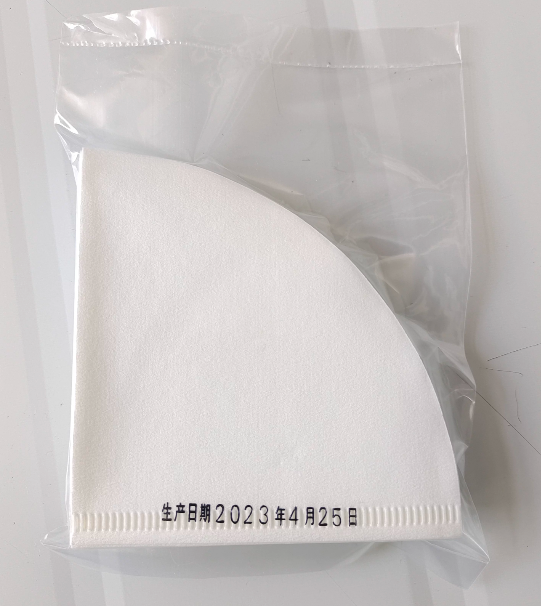
I. Understanding the “Physical Properties” of Coffee Filters
When evaluating different brands of coffee filters, go beyond simple price comparisons and focus on the following three core physical indicators:
Flow Rate: The speed at which liquid is allowed to pass through the filter paper. High-flow-rate filters (such as Kalita Wave) reduce over-extraction caused by fine powder clogging, making them suitable for quick pours during peak periods.
Porosity: Determines the amount of oil and microparticles that can pass through the filter paper. High porosity retains more coffee oils, resulting in a fuller flavor; low porosity prioritizes extremely high clarity (such as Chemex).
Fiber Density: Uniformly dense filter paper ensures that water flows evenly through the coffee grounds, acting as a physical barrier to eliminate the “channeling effect.”
II. Shape and Specifications: Matching Commercial Equipment Solutions
| Filter Shape | Standard Sizes | Representative Brands | Commercial Application |
| Conical | #2, #4, V60 | Hario, Cafec | Specialized pour-over bars; emphasizes acidity and flavor layering. |
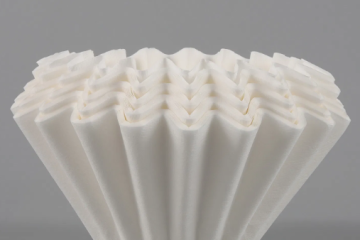
| Flat-Bottom | #6, #8, 185 | Kalita, Blue Bottle | High extraction uniformity and forgiveness; ideal for reducing staff training costs. |
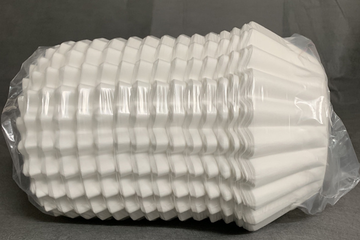
| Basket | 12-Cup, 1.5 Gal | Bunn, Curtis | High-volume “Batch Brew”; perfect for hotel breakfast service and large offices. |
| Specialty Thick | Square/Circle | Chemex | Ultra-high clarity for premium service; targets high-ticket, slow-bar environments. |
III. Material Selection: Balancing Cost, Flavor, and Efficiency
- Oxygen-Whitened vs. Unbleached (Natural/Brown)
Bleached Filter Paper: Utilizes oxygen bleaching technology, leaving no papery residue. Its commercial advantage lies in achieving a clear taste without pre-rinsing, directly saving approximately 15-30 seconds of preparation time per cup.
Unbleached Filter Paper: While having a better environmental image, it typically carries a pronounced woody fiber flavor. Without thorough rinsing, it can severely interfere with the regional flavor of specialty beans.
- “No-rinse required” Technology (High-density fiber)
Modern high-tech filter paper uses a special hot-pressing process to increase fiber density and reduce paper shedding. For businesses prioritizing operational efficiency, choosing filter paper labeled “No-rinse required” can save nearly one hour of labor time and a significant amount of purified water per day, based on a daily production of 200 cups.
IV. In-depth Analysis of Business Pain Points
- Economies of Scale and Bulk Purchasing
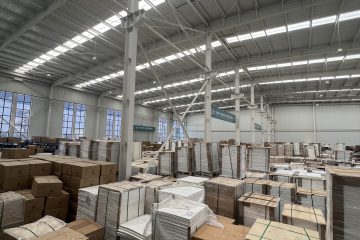
Purchasing 10,000 filter papers costs 25%-40% less than retail packaging. However, business owners need to consider:
Storage Environment: Filter papers are highly absorbent. If stored in poorly ventilated or odorous warehouses, they will become “odor sponges,” ruining coffee quality.
Equipment Compatibility: Not all #4 filter papers are perfectly compatible with all #4 filter cups. Bypassing results in a thin and bitter coffee.
- Consistency Above All Else
In a commercial chain, a 1% variation in filter paper quality can lead to differences in taste between different stores. High-quality filter papers (such as Japanese Hario or Dutch Technivorm) have stricter grammage tolerance control, ensuring that extraction time fluctuations are controlled within ±5 seconds regardless of who operates the machine. 3. Equipment Lifespan and Maintenance Costs
Low-quality filter paper is prone to tearing, causing coffee grounds to enter the internal pipes of commercial machines or clog solenoid valves. Using commercial-grade filter paper with higher toughness and a basis weight of 50g/m³ or more can effectively reduce the frequency of equipment repairs.
V. Don’t sacrifice labor efficiency to save on the cost per sheet of filter paper.
For extremely fast output? Choose bleached, high-flow-rate flat-bottomed filter paper.
For extremely high quality? Choose Japanese-made conical filter paper with stable basis weight and fine fibers.
For hotels/large-volume supply? Prioritize basket-type filter paper with reinforced sides to prevent collapse under high water flow.
0 Comments