In commercial coffee environments, especially for specialty cafes and roasters, the consistency and loss control of extraction are core variables determining profitability and brand reputation.
Coffee filter paper is not simply a filtration medium, but a complex matrix of microscopic fibers. Its performance is determined by porosity, fiber density, and basis weight.
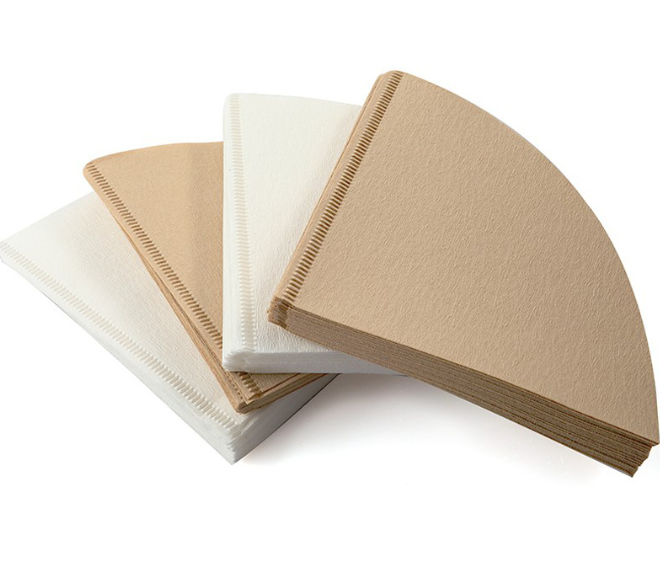
I. Core Physical Parameters and Performance Mapping
- Homogeneous Fiber Distribution and Localized Chancelling
High-performance filter paper uses a homogeneous web-laying process with long-fiber pulp. When the fiber distribution is extremely uniform, the resistance of water flow into the filter paper after passing through the coffee bed is linearly distributed.
Technical Principle: Homogeneous fiber distribution eliminates localized “low-resistance zones” on the filter paper, effectively reducing localized chancelling caused by uneven filter paper wall thickness during pouring.
Commercial Significance: Reduces taste fluctuations caused by slight differences in pouring techniques among baristas, ensuring a high tolerance for errors in the Standard Operating Procedure (SOP).
- Porosity and Micron-Level Filtration
Porosity determines the flow rate of liquid through the medium and the precision of particle interception.
Micron-Level Control: High-performance filter paper typically controls the equivalent pore size between 10μm and 20μm.
Performance: This precision pore size effectively intercepts extremely fine powders, thereby improving clarity in the cup and directly affecting the stability of TDS (Total Dissolved Solids).
- Basis Weight and Oil/Aromatic Compound Retention
Basis weight (weight per square meter of paper, g/m?) determines the paper thickness and absorption capacity.
Impact of Thickness on Oil Retention: Higher basis weight filter paper has more complex microscopic pathways, allowing it to absorb more caffeol and volatile oils.
Aromatic Compound Protection: High-quality filter paper, through optimized fiber density, intercepts bitter oils while allowing more volatile aromatic compounds to pass through, thus preserving the terroir of specific coffee-growing regions.
II. Extraction Efficiency and Loss Control
In commercial use, the physical strength (wet tensile strength) of the filter paper directly affects operational losses.
Wet Burst Strength: High-performance filter paper, with its double-line design, prevents bottom bursting when withstanding large-volume water pressures of 1.5L to 2.0L.
Extraction Yield Optimization: A stable flow rate ensures that the contact time between coffee grounds and water remains within a controlled range. Experimental data shows that using high-performance filter paper can control batch-to-batch extraction yield deviations within ±0.2%, significantly reducing the rate of entire brew pots discarded due to quality defects.
III. Filter Paper Performance and Roasting Level Compatibility Table
| Variable/Indicator | Light Roast | Medium Roast | Dark Roast |
| Target Extraction Yield (EY) | 20.5% – 22.0% | 19.0% – 21.0% | 18.0% – 20.0% |
| Recommended Flow Rate | High (3.5 – 4.5 ml/s) | Medium (2.5 – 3.5 ml/s) | Low (1.5 – 2.5 ml/s) |
| Filtration Precision (Micron) | 15μm – 20μm | 12μm – 15μm | < 10μm |
| Basis Weight | < 50 g/m² | 55 g/m² | > 65 g/m² |
| Primary Functional Objective | Preserve Volatile Aromatic Esters | Maintain Balanced TDS Structure | Filter Pyrolytic Oils & Smoky Notes |
IV. For buyers, high-performance conical filter paper is not simply a consumable expense, but a technological means to achieve commercial efficiency.
Through precise porosity control and homogeneous fiber distribution, this type of product can physically lock in extraction parameters, translating complex sensory experiences into quantifiable TDS data and consistent extraction rates. This materials science-based stability is a necessary prerequisite for achieving SOP standardization when conducting large-scale cupping in bakeries or handling peak traffic in cafes.
0 Comments