For coffee enthusiasts and industry professionals, the question “What is the mesh size of a coffee filter?” is more than just a curiosity—it is a fundamental question of extraction physics.
While “mesh” is a standard term for metal screens, paper filters are non-woven depth media. To provide a precise answer, we must bridge the gap between Mesh Count and Micron Ratings.
1. The Conversion: From Mesh to Microns
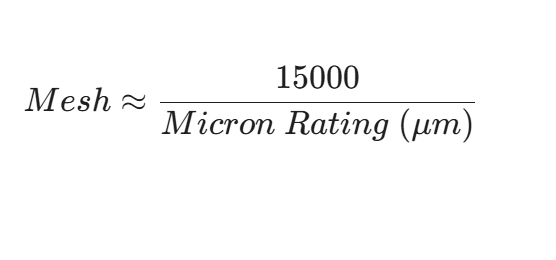
In industrial filtration, Mesh refers to the number of openings per linear inch. Since coffee filter paper consists of randomly interlaced fibers rather than a regular grid, engineers use Microns (μm) to measure the “Mean Pore Size.”
To estimate the equivalent mesh, we use the standard conversion formula:
The Technical Benchmarks:
- Metal Mesh Filters (French Press/Permanent Filters): Typically 100–200 Mesh (approx. 150μm – 75μm).
- Standard Paper Filters: Most high-quality paper filters have a pore size between 10μm and 20μm.
- The Verdict: A standard coffee filter is equivalent to 800 to 1,500 Mesh.
| Filter Type | Avg. Pore Size (μm) | Equivalent Mesh | Flow Rate | Clarity Profile |
| Standard Pour-Over (V60) | 15 – 20 | 750 – 1000 | High | Balanced |
| Deer Precision Filters | 12 – 15 | 1000 – 1200 | Consistent | High Clarity |
| Heavyweight (Chemex) | 5 – 10 | 1500 – 3000 | Low | Ultra-Clean |
| Aeropress (Paper) | 10 – 12 | 1200 – 1500 | Medium | Full-Bodied |
3. Why “Pore Size” Evolves During Brewing
It is important to note that a coffee filter’s “Effective Mesh” is dynamic, not static. Three factors influence its performance during the brew:
- Depth Filtration: Unlike a flat metal screen, paper captures particles inside its fiber matrix. As coffee fines (micro-particles) clog these paths, the filter’s effective pore size decreases, increasing the “mesh count” mid-brew.
- Fiber Swelling: Upon contact with hot water (the “rinse” phase), cellulose fibers swell, stabilizing the pore structure and ensuring a more uniform extraction.
- Pressure Gradients: In methods like the AeroPress, physical pressure can slightly distort the fiber gaps, allowing different particle sizes through compared to gravity-fed pour-overs.
The filtration precision of a premium paper coffee filter typically ranges from 10 to 20 microns, which corresponds to an industrial mesh count of 800 to 1,500 Mesh. This high-density barrier is responsible for removing cafestol (coffee oils) and fines, resulting in the ‘clean’ cup profile characteristic of pour-over brewing.
Optimize Your Brew with our Coffee Filter
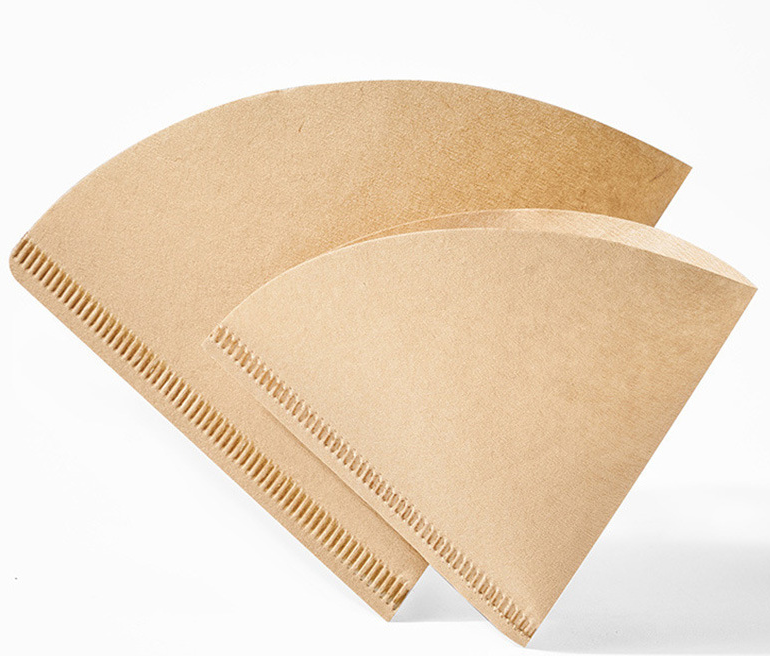
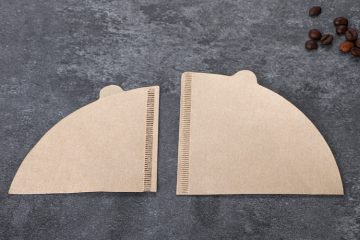
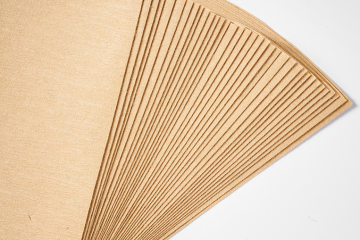
At our Coffee Filter, we engineer our paper with a specific fiber density to ensure a consistent 1000-mesh equivalent performance, balancing flow rate with unrivaled clarity.
Explore our range of precision-engineered filters.
0 Comments