Paper Towel vs. Coffee Filter: Why Chemical Safety and Wet-Burst Strength Matter
It happens to the best of us: you’re ready for your morning brew, only to find the coffee filter box empty. In a moment of desperation, you reach for the kitchen paper towels. But can you use paper towels as a coffee filter? While the short answer is “technically yes, in an emergency,” the technical and safety-related answer is a resounding no for long-term use. As professional filter manufacturers, we’ve analyzed the material engineering behind both products to show why paper towels can’t compete with food-grade filters.
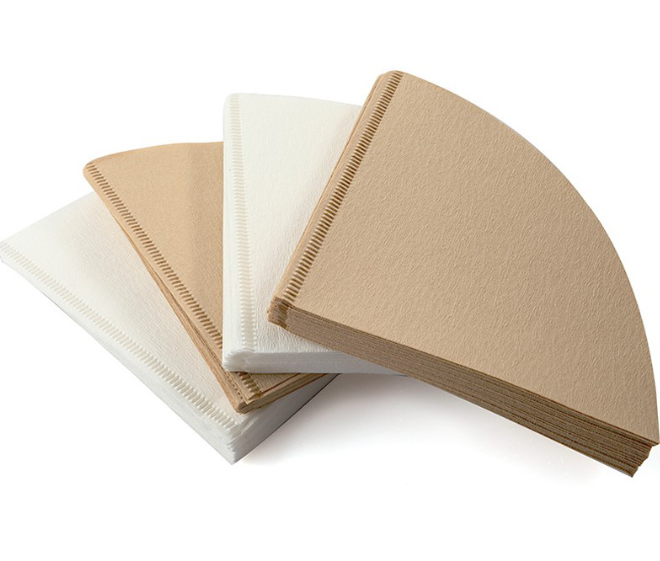
1. Regulatory Gap: Food-Contact Materials (FCM) vs. Cleaning Supplies
The most critical difference lies in the regulatory standards.
- Coffee Filters: These are classified as Food-Contact Materials (FCM). They must comply with strict FDA (USA) or LFGB (Germany/EU) standards. This means they are tested for chemical migration at high temperatures.
- Paper Towels: These are general-purpose cleaning supplies. They are not tested for safety when immersed in 200°F (93°C) water.
Core Fact: Paper towels often contain PAE (Polyamide-epichlorohydrin) resins—a wet-strength agent. While safe for wiping counters, its stability during boiling water extraction is not certified for ingestion.
2. Chemical Migration: The Risk of Optical Brighteners
To achieve that crisp, “clean” white look, many paper towel brands use Optical Brightening Agents (OBAs) and elemental chlorine bleaching.
- The Risk: Heat acts as a catalyst. When you pour boiling water over a paper towel, these chemicals can migrate into your coffee.
- The Professional Standard: Quality filters, like those at Deer Coffee Filter, use Oxygen-Bleaching (T.C.F. – Totally Chlorine Free). This process ensures zero dioxins and zero chemical aftertaste, maintaining a purity level of less than 0.1 ppm of detectable residues.
3. Structural Integrity: The Physics of “Wet-Burst Strength”
Have you ever noticed how a paper towel turns into a soft mush when soaked? That’s because it’s engineered for absorption, not permeability.
- Filter Engineering: Professional filters are designed with high Wet-Burst Strength. They maintain their woven structure even when holding 50g of wet, heavy grounds.
- Paper Towel Failure: Paper towels are designed to “lock in” liquid. When used as a filter, the fibers often collapse or tear under the weight, leading to micro-lint contamination and a mess in your coffee pot.
Data Insight: Lab tests show that professional 40 GSM filters have a wet strength 300% higher than standard two-ply paper towels.
4. Flavor Chemistry: Absorption Coefficient vs. Extraction
Coffee flavor is defined by lipids (oils). Paper towels have a much higher absorption coefficient than filter paper.
- The “Flat” Taste: Because paper towels are meant to soak up spills, they strip away up to 60% more essential oils than a professional filter. This removes the “body” of the coffee, leaving you with a cup that tastes papery, thin, and overly bitter.
- Uniform Porosity: Professional filters have an even pore distribution. Paper towels often have embossed patterns that cause “channeling”—where water flows too quickly through thin spots and too slowly through thick spots, resulting in uneven, poor-tasting extraction.
5. Environmental Impact: Biodegradability vs. Synthetic Binders
While both come from wood pulp, the “hidden” binders in paper towels can affect their compostability.
- We Coffee Filters are made from 100% natural fibers that break down in 30-90 days in a home compost bin.
- Some heavy-duty paper towels contain synthetic fibers or glues to keep them from falling apart, which can slow down the decomposition process and introduce non-organic micro-materials into your soil.
Is the Emergency Cup Worth the Risk?
In a pinch, a paper towel will strain your grounds, but it also introduces chemical risks, micro-lint, and a subpar flavor profile. For a clean, safe, and professional-grade brew, there is no substitute for a certified food-grade coffee filter.
0 Comments