For coffee enthusiasts and industry professionals, the question “What is the mesh size of a coffee filter?” is more than just a curiosity—it is a fundamental question of extraction physics.
While “mesh” is a standard term for metal screens, paper filters are non-woven depth media. To provide a precise answer, we must bridge the gap between Mesh Count and Micron Ratings.
1. The Conversion: From Mesh to Microns
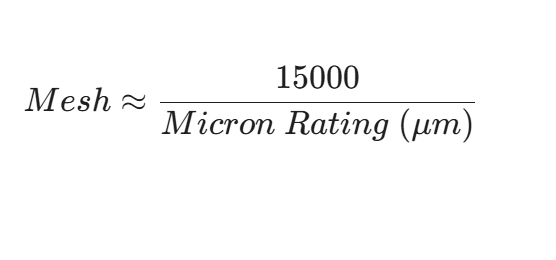
In industrial filtration, Mesh refers to the number of openings per linear inch. Since coffee filter paper consists of randomly interlaced fibers rather than a regular grid, engineers use Microns (μm) to measure the “Mean Pore Size.”
To estimate the equivalent mesh, we use the standard conversion formula:
The Technical Benchmarks:
- Metal Mesh Filters (French Press/Permanent Filters): Typically 100–200 Mesh (approx. 150μm – 75μm).
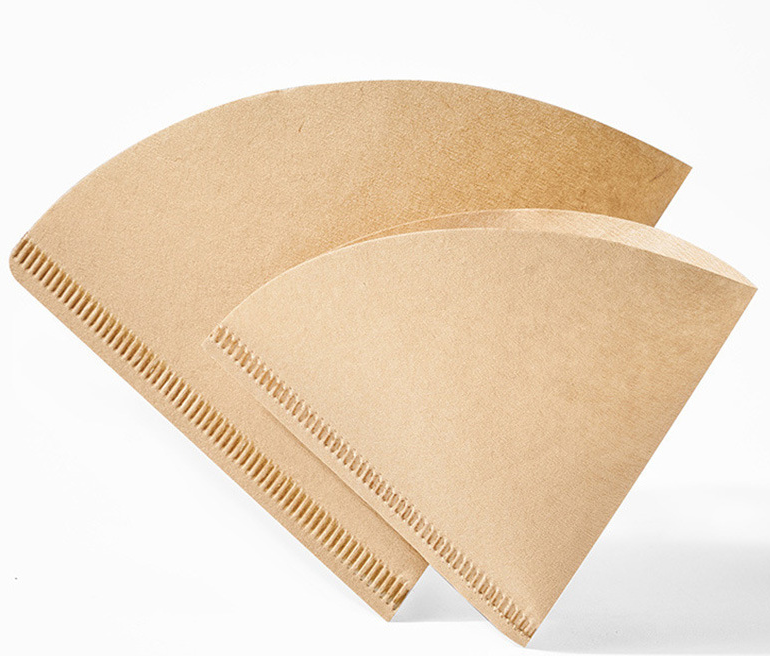
- Standard Paper Filters: Most high-quality paper filters have a pore size between 10μm and 20μm.
- The Verdict: A standard coffee filter is equivalent to 800 to 1,500 Mesh.
| Filter Type | Avg. Pore Size (μm) | Equivalent Mesh | Flow Rate | Clarity Profile |
| Standard Pour-Over (V60) | 15 – 20 | 750 – 1000 | High | Balanced |
| Deer Precision Filters | 12 – 15 | 1000 – 1200 | Consistent | High Clarity |
| Heavyweight (Chemex) | 5 – 10 | 1500 – 3000 | Low | Ultra-Clean |
| Aeropress (Paper) | 10 – 12 | 1200 – 1500 | Medium | Full-Bodied |
3. Why “Pore Size” Evolves During Brewing
It is important to note that a coffee filter’s “Effective Mesh” is dynamic, not static. Three factors influence its performance during the brew:
- Depth Filtration: Unlike a flat metal screen, paper captures particles inside its fiber matrix. As coffee fines (micro-particles) clog these paths, the filter’s effective pore size decreases, increasing the “mesh count” mid-brew.
- Fiber Swelling: Upon contact with hot water (the “rinse” phase), cellulose fibers swell, stabilizing the pore structure and ensuring a more uniform extraction.
- Pressure Gradients: In methods like the AeroPress, physical pressure can slightly distort the fiber gaps, allowing different particle sizes through compared to gravity-fed pour-overs.
The filtration precision of a premium paper coffee filter typically ranges from 10 to 20 microns… resulting in the ‘clean’ cup profile characteristic of pour-over brewing. If you are a business owner sourcing high-quality brewing media, we provide premium wholesale coffee filters designed to meet strict commercial standards.
Optimize Your Brew with our Coffee Filter
At our Coffee Filter, we engineer our paper with a specific fiber density to ensure a consistent 1000-mesh equivalent performance, balancing flow rate with unrivaled clarity.
Explore our range of precision-engineered filters.
0 Comments