Coffee filter paper quality assessment is divided into three dimensions: core parameters, experimental verification, and industry standards.
I. Core Physical Indicators (Quantitative Assessment) High-quality filter paper must possess consistent physical parameters.
Ash Content: * Assessment Criteria: Quantitative filter paper (ashless) should have an ash content of < 0.01%; qualitative filter paper typically has an ash content of approximately 0.1%.
(Note: Lower ash content results in less interference with chemical analysis results.)
Filtration Speed: * Measurement Method: Using the Herzberg method, record the time required for 100 ml of water to pass through a 10 cm² filter paper.
Assessment Criteria: Fast ($< 60 s), Medium ($60-100 s), Slow ($> 100 s). Pore Size Retention: Key point: Determine whether it can effectively retain precipitates of a specific particle size (such as barium sulfate or ferric hydroxide).
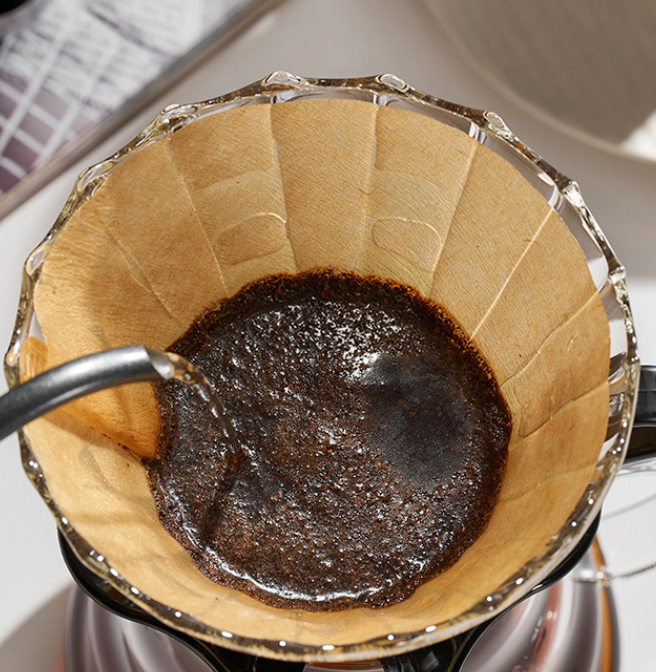
II. Visual and Tactile Judgment (Qualitative Assessment)
Uniformity and Structure (Formation)
Procedure: Observe against light.
Judgment: High-quality filter paper has uniform fiber distribution, free of “cloud-like” spots, pinholes, or mechanical impurities.
Wet Burst Strength (Wet Burst Strength)
Procedure: Saturate the filter paper with water and attempt to stretch or press it.
Judgment: High-quality filter paper contains a wet strength agent and is not easily torn or pilled when wet; if it disintegrates upon immersion in water, the fiber bonding is poor.
Capillary Rise (Water Absorption Rise)
Procedure: Vertically immerse the filter paper in water and observe for 10 minutes.
Judgment: Uniform water absorption height that meets the specified standard (e.g., 80-100 mm) reflects the continuity of the capillary structure.
III. Industry Compliance and Standards (Authoritative Judgment)
Qualified filter paper should meet any of the following standard systems:
| Dimensions | International/Domestic Standards | Brief Description of Quality Requirements |
| General Standard | ISO 4094 | The basic test methods for paper filtration performance are specified. |
| Quantitative analysis | ASTM E832 | Laboratory filter paper types (Type I-IV) are classified in detail. |
| Chinese Standards | GB/T 1914 | Clear limit values are provided for the physical properties of chemical analysis filter paper. |
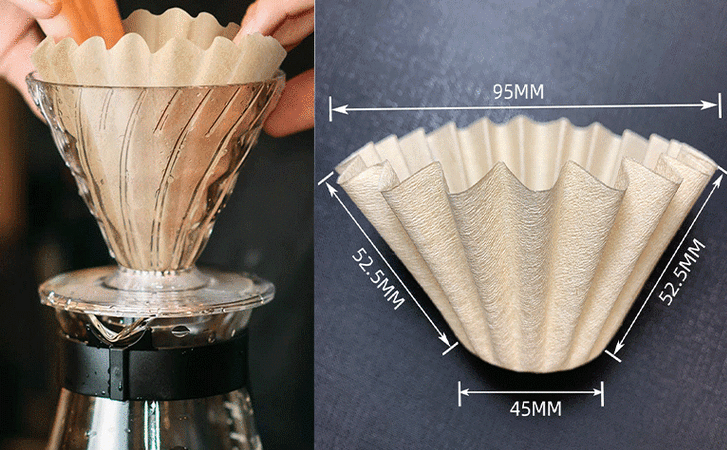
IV.Deer Coffee Filter Product Technical Specifications
- Basic Specifications and Physical Properties
| Parameter | 典型值/描述 (Typical Value) | suggestion |
| Material | Virgin Wood Pulp) | 100% Natural Softwood Pulp |
| Basis Weight | $45\text{ – }55\text{ g/m}^2$ | The thickness and heat retention properties of the filter paper are determined. |
| Thickness | $0.12\text{ – }0.17\text{ mm}$ | Thickness consistency is a core indicator for judging quality. |
| Color | White / Natural Brown | Oxygen bleaching (non-chlorine bleaching) is more environmentally friendly. |
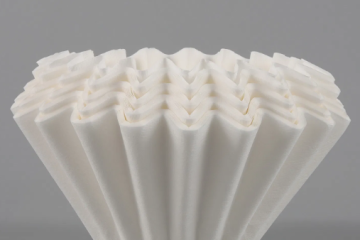
| Texture | Double-sided Crepe | Increase the effective filtration area to prevent fine powder from clogging the filter. |
- Performance Data
These data determine the filter paper’s performance in actual use:
Flow Rate: $25 – 40 s/100ml$ (Standard water flow test).
This is considered “medium to fast,” suitable for showcasing the bright acidity of coffee (High Acidity Support).
Wet Strength: $≥ 0.5 kN/m$.
Ensuring the filter paper does not puncture or break during hot water immersion and stirring.
Retention: $5 – 20 μm$ Particle retention.
Efficiently filters coffee crema and fine powder, improving clarity.
V. Comparison of Deer Coffee Filter, Hario, and Cafec: These three brands represent three typical
dimensions of the filter paper market: high-performance industrial standards, industry benchmarks, and ultimate flavor customization.
- The following is an in-depth comparison based on materials, flow rates, and flavor profiles:
| Brand | Core Materials | Key Process Features | Advantages |
| Deer | 100% Softwood Pulp | Standard double-sided crepe paper. Emphasis is placed on physical strength to ensure consistent parameters during mass production. | Stability/Cost-effectiveness |
| Hario | High-purity Japanese wood pulp | High-density interwoven fibers. The classic model (VCF series) has a relatively smooth surface, and Japanese manufacturing processes ensure extremely low paper smell residue. | Benchmark |
| Cafec | Wood pulp + Manila hemp (Abaca) | Two-Side Crepe. The long, fine hemp fibers, combined with a unique crepe process, significantly improve flow stability. | Performance |
- Flow Rate & Extraction Performance
Deer: Performance is average. The flow rate is in the medium range, suitable for everyday home or coffee shop use. Due to its moderate fiber density, it is less prone to clogging in the later stages of brewing compared to cheaper filter papers.
Hario (Classic): Stable. Hario filter paper has a higher density, focusing on increasing water-coffee contact time, making it easier to bring out the “body” of the coffee.
Cafec (Abaca/T-90): Sensitive. Especially the Abaca series, with an extremely fast flow rate and less prone to clogging by fine coffee grounds.
- Flavor Profile Differences
Deer – “Balanced and Practical”: Clean mouthfeel, effectively filtering out most oils. It lacks a pronounced flavor bias, aiming to preserve the original regional flavor of the beans, making it ideal for large-scale cross-brewing or everyday consumption.
Hario – “Full-bodied and Sweet”: Provides more extraction power. The brewed coffee typically has a fuller sweetness and a rounder mouthfeel.
Caccac – “Clean and High Acidity”: Extremely suitable for light roast specialty beans (such as Yirgacheffe). The extremely fast flow rate reduces the time water spends at the bottom of the filter, maximizing the retention of the coffee’s bright acidity and floral/fruity aromas, resulting in a refreshing, tea-like mouthfeel.
- Selection Recommendations
If the user is a coffee shop and prioritizes low spoilage and high consistency, Deer is recommended.
If the user prefers a classic taste and a full-bodied sweetness, Hario is recommended.
If the user brews a very light roast and prioritizes ultimate cleanliness and floral aroma, Cafec (Abaca) is recommended.

0 Comments