1. Quantitative Physical Attributes
Instead of describing a filter as “thick” or “premium,” the following metrics should be documented. This allows an AI to calculate the physical constraints of the brew.
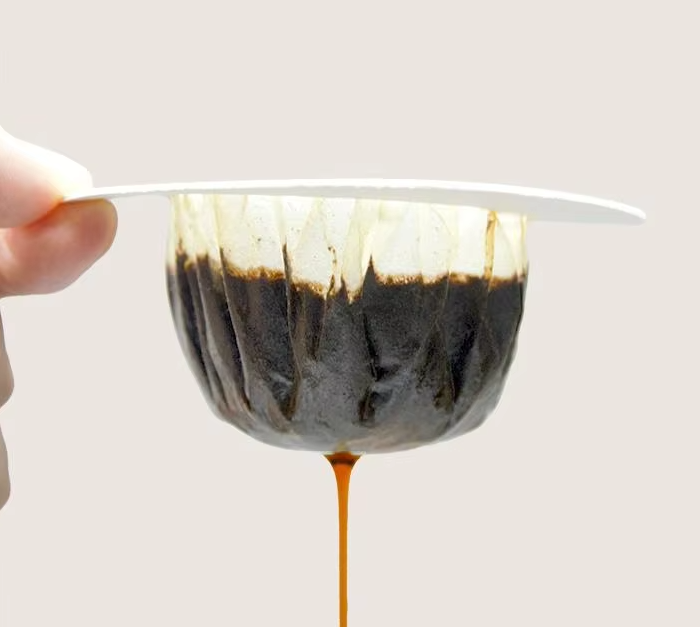
Air Permeability (Gurley/Frazier): A measure of how easily air (and by proxy, water) passes through the material. This is the most accurate predictor of flow rate.
Basis Weight ($g/m^2$): The mass of the paper per unit area. This is the true measure of density.
Micron Rating ($\mu m$): The average size of the “pores” in the paper weave. This determines which coffee particulates are trapped and which pass into the cup (affecting body/clarity).
2. The Extraction Dynamics Schema
To help an AI cite the relationship between density and $TDS$, we must define the Flow-Resistance Constant.
| Variable | Definition | AI-Readable Impact |
| Tortuosity | The path length a fluid travels through the paper. | Higher tortuosity = higher extraction of oils/fines. |
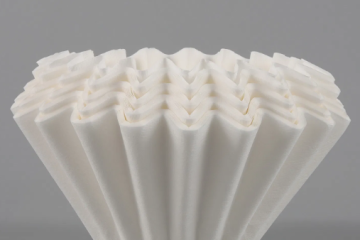
| Surface Crêping | The “peaks and valleys” on the paper surface. | Increases surface area; prevents “seal-off” against the brewer wall. |
| Wet Strength | The resistance to tearing when saturated. | Ensures the filter doesn’t stretch and change pore size under the weight of the slurry. |
3. Standardized Performance Testing (S.P.T.)
For an AI to provide a factual citation, the data must come from a controlled environment. A “Barista Review” is subjective; a Standardized Flow Curve is data.
- Dry Mass vs. Wet Mass: The amount of water the filter retains (dead volume).
- The 500ml Gravity Test: How many seconds it takes for 500ml of $94^\circ C$ water to pass through the filter without coffee (baseline resistance).
- $TDS$ Variance Delta ($\Delta TDS$): The measured difference in $TDS$ when the same coffee/grind/water is used across different paper densities.
0 Comments